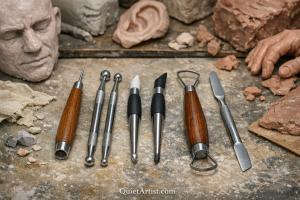
You have not bought the wrong hobby. You have almost certainly bought the wrong tools — and that is a completely different problem, with a short answer: five clay sculpting tools that experienced sculptors reach for on every project, that cost very little, and that will do what you have been trying and failing to get your current set to do.
The drawer full of tools you never touch is not evidence that you are doing something wrong. It is evidence that most beginner sets are built for a different discipline entirely. Here is what happened, and what to do about it.
The Pottery Kit Mistake — and Why It Is So Easy to Make
The sets sold in craft stores and on Amazon as clay sculpting tools are, in most cases, pottery tools. Not sculpting tools. Pottery tools. The packaging uses words like “clay” and “sculpting” and “modelling” interchangeably, which makes the distinction invisible until you are already frustrated.
Pottery is built around a spinning wheel. The clay is wet, large in volume, and moving fast. The tools match — broad, rounded, built for sweeping gestures across a surface the size of a dinner plate. They smooth the outside of a bowl. They trim the base of a vessel. They are excellent at what they do.
Sculpting is a completely different problem. You are building and refining form at small scale. You need to get into an eye socket the width of your thumbnail. You need to blend the seam where a hand meets a wrist without disturbing the fingers you already shaped. You need to remove a thin layer from the underside of a jaw to suggest the angle of bone beneath it. Pottery tools cannot do any of that. They are too broad, too blunt, and built for a different discipline entirely.
The frustration you felt when the tools did not do what you wanted was not a sign that sculpting is not for you. It was the correct response to using the wrong instrument for the job.
What to Do With the Kit You Already Have
Do not throw it away. Pottery tools have a place in sculpture — just not for detail work. The broad flat spatulas are useful for smoothing large background areas. Rounded wooden tools are good for blocking in rough form before refining begins. Think of them as the rough sandpaper in a woodworking kit — they have a purpose, but you would not use them to finish a surface.
What you are missing is a small set of tools built specifically for the work you are trying to do. Not fifty tools. Five.
The Five Clay Sculpting Tools That Solve Real Problems
Sculptors working in polymer clay, oil-based clay, and air-dry clay arrive independently at the same short list. These are not the most glamorous tools. They are the ones that get reached for on every project because each one solves a problem you will face constantly.
The Needle Tool — for When Clay Will Not Go Where You Want It
A metal point on a handle. When you are trying to score two pieces before joining them so they actually bond rather than fall apart — this is the tool. When you need to poke a hole without distorting the clay around it — this is the tool. When you want to draw a hair line, a fabric crease, or a fine wrinkle — this is the tool. A cheap needle tool bends under pressure. Buy a metal one and it will last for years.
The Ball Stylus — for When You Need to Push In Without Tearing
A metal rod with a rounded ball at each end. The moment you need it is unmistakable: you are trying to create a concave shape — an eye socket, a nostril, the curve of an ear — and every time you push with your finger, the clay around it distorts and loses its form. The ball stylus pushes in smoothly, rolling against the clay rather than dragging it, leaving a clean curved depression. Buy a set with a few sizes. The smallest will be the one you use most.
Silicone Tipped Tools — for When Seams Will Not Disappear
Soft rubber tips on a handle. Every time you join two pieces of clay — a head to a neck, a nose to a face, an arm to a shoulder — there is a seam. If you use a rigid tool to blend it, the clay drags and leaves a ridge. If you use your finger, you flatten the detail around it. The silicone tip moves with the clay, blending the joint while leaving the surrounding surface intact. This is the tool that makes a sculpted figure look finished rather than assembled from parts.
The Loop Tool — for When There Is Too Much Clay
A bent wire forming a loop, used for removing material rather than moving or adding it. You will not understand why you need this until the moment you do — and then you will understand completely. The jaw is too heavy. The brow is reading as flat because there is too much clay above the cheekbone. The loop tool carves back cleanly, taking thin layers of material without collapsing the structure around it. Most beginners do not own one. Most experienced sculptors say it is the one they could not work without. Buy it before you think you need it.
A Flat Dental Spatula — for When Surfaces Need a Clean Edge
Dental tools are not sold as art tools, but sculptors have used them for decades. The angled metal head reaches into corners a straight tool cannot access. The flat blade smooths a surface with precision — useful when you need a clean edge rather than a blended one. Dental supply websites sell them individually for very little. Many experienced sculptors buy their most-used tools there rather than from art retailers, because the metal is better and the shapes are more useful.
One Thing the Kits Never Mention
The clay sculpting tools that work best depend partly on your clay. Silicone tips work beautifully on fresh polymer clay but become less effective as it firms up — at that point metal tools take over. Oil-based professional clay stays workable indefinitely, so you can use loop tools aggressively without rushing. Air-dry clay begins setting as soon as it meets air, so joining seams needs to happen while both surfaces are still receptive.
If you are still deciding on a clay, Sculpey’s beginner guide to clay types and tools is an honest and clear starting point — worth reading before you commit to a material.
The Only Rule Worth Following
Buy clay sculpting tools when a project shows you that you need them. The loop tool means nothing until you are standing in front of a piece with too much clay in the wrong place and no way to remove it cleanly. At that moment you will know exactly what you need, why you need it, and what to look for. That is when to buy it.
Five specific tools bought for specific reasons will take you further than fifty tools bought because they came in the same box. You are not behind. You just needed to know which five.