Clay Sculpting Tools Names: Why the Same Tool Has Five Different Names (And What to Actually Call Them)
You are watching a tutorial. The instructor picks up a tool and says “grab your ribbon tool.” You look at your kit. Nothing is labelled ribbon tool. There is something with a metal loop on it. There is something that might be a scraper. You are not sure if they are the same thing. You pause the video, search “ribbon tool clay,” and land on a page selling pottery equipment that looks nothing like what you need.
This is the real problem with clay sculpting tools names — not that the tools are complicated, but that the same tool gets called entirely different things depending on who made it, who is teaching, and whether the source comes from a pottery tradition or a figurative sculpting tradition. A beginner has no way of knowing this. They buy a kit, watch tutorials, and cannot match one to the other.
This guide fixes that. For each essential tool, you will find every name it commonly goes by, what it looks like, and what it does — so you can follow any tutorial, search any supplier, and identify what you already own.
Why Clay Sculpting Tools Names Are So Inconsistent
Two different traditions — pottery and figurative sculpting — developed their own tool names independently, and their tools overlap without ever quite matching. A ribbon tool in a pottery context is used for trimming wheel-thrown pots. A ribbon tool in a sculpting context may be an entirely different shape used for carving detail. Both groups also borrow from dental tools, nail art tools, wax carving tools, and cake decorating equipment, each of which has its own naming conventions.
Manufacturers compound the confusion by naming products whatever they think will sell — “detail tool,” “modeling tool,” “clay shaper” — without any consistency across brands. When an expert sculptor in a forum tells you that the Amazon kit you bought is full of “pottery tools, not sculpting tools,” they are pointing at exactly this problem. The tools may look similar and share names, but they are shaped for different purposes.
Knowing this does not solve the problem on its own, but it explains why looking up a tool by the name one tutorial uses often leads nowhere.
The Essential Clay Sculpting Tools Names and Their Aliases
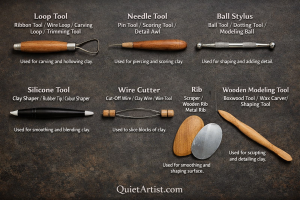
The Loop Tool
Also called: ribbon tool, wire loop tool, trimming tool, carving loop, scraper loop.
A wooden or metal handle with a loop of sharpened metal at one or both ends. The loop is used to remove clay — carving away material, hollowing forms, and refining large shapes. In pottery it is often called a trimming tool or ribbon tool and is used to clean up wheel-thrown pots. In sculpting it is the same object but used for carving mass rather than finishing surfaces. When a tutorial says “use your ribbon tool to carve out the eye socket,” this is the tool. When it says “loop tool,” this is also the tool. Sizes range from large loops for bulk removal to small, fine loops for detail work.
The Needle Tool
Also called: pin tool, scoring tool, stylus (when fine-pointed), awl, detail needle, wire tool.
A sharp metal point set in a handle. This is one of the most consistently named tools in clay work — “needle tool” appears across both pottery and sculpting traditions — but it is sometimes sold as a “pin tool” or listed as a “scoring tool,” which describes one of its uses rather than the tool itself. It is used for piercing, scoring clay before joining pieces, adding fine texture, and scribing lines. In figurative work, a very fine needle tool is sometimes called a detail stylus, which overlaps with the ball stylus category below.
The Ball Stylus
Also called: ball tool, dotting tool, ball-end tool, embossing tool, modeling ball, round-tip stylus.
A metal rod with a small ball at one or both ends, in varying sizes. This is where naming confusion is worst. The same tool appears in nail art kits as a “dotting tool,” in cake decorating kits as a “ball tool,” and in sculpting kits as a “ball stylus” or “modeling ball.” They are functionally identical. The ball end is used to press into clay to create sockets, smooth small surfaces, push clay into recesses, and blend joints. When a sculptor says “use your ball tool to press in the eye socket,” any of these versions will work.
The Silicone Tool
Also called: clay shaper, rubber-tip tool, silicone brush, colour shaper, tip shaper, blending tool.
A handle with a soft silicone tip in various shapes — pointed, flat, rounded, tapered. The tips flex slightly and are used to smooth clay surfaces, blend joins, and reach into tight areas without leaving marks. They are sold under “colour shapers” in fine art contexts, “clay shapers” in sculpting contexts, and “silicone nail tools” in nail art contexts. The nail art versions are typically smaller and work well for fine detail. When a tutorial says “smooth that join with a silicone tool,” any of these will do the job.
The Wire Cutter
Also called: cut-off wire, clay wire, wire tool, clay cutter.
A length of wire or fishing line with handles at each end, used to cut clay blocks and separate finished pieces from a work surface. This is consistently named across sources — almost everyone calls it a wire cutter or wire tool — but beginners sometimes confuse it with the wire loop tool above. The wire cutter is flat wire for cutting through clay; the loop tool is a shaped metal loop for carving into clay. They look different and are not interchangeable.
The Rib
Also called: scraper, kidney tool, flexible scraper, metal rib, wooden rib, rubber rib, pottery rib.
A flat tool, usually curved or kidney-shaped, made of wood, metal, or flexible rubber. In pottery, ribs are used to smooth and shape the walls of thrown pots, and the name “rib” is standard. In sculpting, the same tool is more often called a scraper. A flexible rubber version is called a rubber rib or flexible scraper. When a pottery tutorial says “use your rib to smooth the surface,” they mean this tool. When a sculpting tutorial says “use a scraper to blend the large planes,” they likely mean the same tool in its metal or wooden form.
The Wooden Modeling Tool
Also called: modeling stick, wooden sculpting tool, boxwood tool, wax carver, dental tool, shaping tool.
A wooden tool, often double-ended, with shaped tips for pushing, blending, and detailing clay. These are the most varied in shape of any sculpting tool category — tips can be pointed, spatula-shaped, curved, angled, or rounded — and are named inconsistently across suppliers. In professional contexts they are often called “boxwood tools” after the traditional material. Dental tools and wax carving tools are metal versions of the same concept and often outperform cheap wooden sets for detailed figurative work.
The Pottery Trap: When Tool Names Lead to the Wrong Thing
One issue beginners consistently run into is searching for clay sculpting tools names and being directed to pottery tools. Pottery tools and sculpting tools share names and sometimes overlap in use, but pottery tool kits are built around wheel-throwing — they contain tools optimised for working with wet clay on a spinning wheel, which is different from hand-building or figurative sculpting.
A pottery kit will typically serve you well for wire cutters, needle tools, sponges, and ribs. It will be less useful for the fine loop tools, silicone shapers, and ball styluses that figure sculpting and character work depend on. If you bought a general pottery kit expecting to sculpt figures and found it lacking, this is why. This overview of sculpting-specific tools for beginners covers the distinction in more detail and is worth reading before your next purchase.
A Note on Searching for Clay Sculpting Tools by Name
Because clay sculpting tools names vary so widely, searching for a specific tool by the name one tutorial uses will frequently return nothing useful. The practical solution is to search by shape and material rather than name — “metal loop clay tool,” “ball end modeling tool,” “silicone tip clay shaper” — or to search the name used in adjacent fields. Nail art tools and cake decorating tools share most of the same shapes as clay sculpting tools and are often better quality at lower prices than sets marketed specifically for clay.
Dental supply catalogues and wax carving tool suppliers are also worth knowing about for fine detail work. The tools are identical in function to dedicated sculpting tools, often better made, and the naming there — scalpel handle, burnisher, wax carver — is at least consistent within its own context.
Once you know that the same tool has five names and can be found in five different sections of any craft supply site, the searching becomes much easier. The tools are not hard to find. They are only hard to name — and now you have the names.