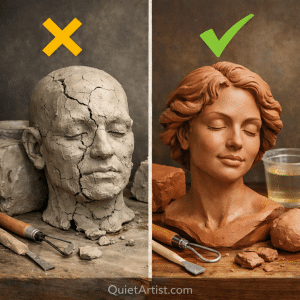
You wanted to start making a clay sculpture. So you looked up which clay to buy. Then you discovered that clay is not just clay — there is polymer clay, air-dry clay, water-based clay, oil-based clay, and paper clay, each with its own tools, techniques, finishing processes, and failure modes. Nobody warned you any of this existed. Now you are reading your fifth comparison article and still have not touched anything.
This is where most beginners stop before they start. Not because the craft is hard, but because the information is designed to cover everything rather than tell you what to do first.
Here is the short answer, before anything else: for a first clay sculpture, buy polymer clay. Specifically, a mid-range brand like Sculpey III or Premo. Then read the rest of this, because there are three things nobody tells you that will determine whether your first piece works or falls apart.
Why Polymer Clay Is the Right Starting Point for Clay Sculpture
Polymer clay does not dry out while you are working. You can put it down, walk away, come back the next day, and it will be exactly as you left it. For a beginner who is still learning how to hold tools and think in three dimensions, this is not a small thing. It removes the time pressure that causes beginners to rush, panic, and produce work that disappoints them before they have had the chance to develop any feel for the material.
It also does not require a kiln. You bake it in a domestic oven at around 275°F, for roughly 15 to 30 minutes depending on thickness. That is the entire finishing process. Compare this to water-based clay, which requires kiln access and hollow construction to survive firing — two technical requirements that have nothing to do with learning to sculpt and everything to do with stopping beginners before they make anything.
Oil-based clay never hardens at all, which means every piece you make must be cast in a mould to become permanent — a separate craft entirely. Air-dry clay cracks unpredictably, especially in anything thicker than about half an inch, and does not hold fine detail well.
None of those are the right starting clay. Polymer is forgiving, permanent, and available in every craft store. Start there.
The Three Things Nobody Tells You
1. Condition the Clay Before You Sculpt
Polymer clay straight from the packet is stiff. If you try to sculpt with it in that state, it will crack, crumble at the edges, and feel nothing like the smooth, workable material you expected. Conditioning means kneading the clay with your hands until it becomes warm and pliable — typically two to five minutes. This step is not optional. It is the difference between clay that works and clay that fights you, and almost no beginner guide mentions it prominently enough.
2. Work From Large Forms to Small Details
Every beginner’s instinct is to start with the details — the eyes, the texture, the fine lines. This is backwards. Clay sculpture works from the outside in, from large to small. Block the overall shape first. Get the proportions roughly right. Only then add detail. If you start with fine work on a form that is not yet correct, you will end up refining something that is fundamentally wrong and have to destroy it to fix it. Work big first, refine later. This principle alone will save more first sculptures than any other piece of advice.
3. Use a Simple Armature for Anything Taller Than Six Inches
An armature is a support structure inside the sculpture — typically aluminium wire bent into the rough shape of what you are making. Without it, anything taller than about six inches will sag under its own weight while you work. Legs bend. Figures lean. You spend the session fixing what gravity is undoing rather than sculpting. A roll of aluminium armature wire costs a few dollars and takes five minutes to bend into position. For small pieces — a head, a hand, an abstract form the size of your fist — you do not need one. For anything standing or tall, it is essential.
What Tools You Actually Need to Start
Very few. The urge to buy a full set of sculpting tools before your first session is understandable and almost always a mistake. You will not know which tools you actually use until you have made two or three pieces.
Start with your hands, a wooden skewer or toothpick for fine detail work, and a smooth ceramic tile or piece of glass to work on. That is a complete beginner setup. A dedicated loop tool for removing material is useful once you start refining surfaces, and a ball stylus is helpful for eye sockets and smooth curves. Buy those when you reach the point where your hands are not sufficient. Not before.
Your First Clay Sculpture Project
Do not start with a face, a full figure, or anything you have strong feelings about getting right. Start with a piece of fruit — a lemon, an apple, a pear. These have interesting forms, clear references you can look at from any angle, and no emotional stakes if the proportions are slightly off.
The goal of your first clay sculpture is not to produce something beautiful. It is to learn how the clay responds to your hands, how it builds up, how it smooths, and how much pressure is too much. A lemon teaches you all of that without the anxiety of trying to capture a likeness.
Once you have made one piece through to the baking stage, you will know more about clay than three hours of reading articles will ever give you. The learning in this craft lives in the doing, not the preparation.
Finishing and Baking Your Clay Sculpture
When your piece is complete, place it on a ceramic tile or oven-safe surface and bake it according to the clay manufacturer’s instructions — typically around 275°F for 15 minutes per quarter inch of thickness. Use an oven thermometer if possible, because domestic ovens can run hot by 20 to 30 degrees, and overheated polymer clay burns and darkens at the edges.
Do not open the oven immediately when the timer ends. Let the piece cool inside with the door cracked for a few minutes. Rapid temperature change can cause surface cracking in thicker pieces.
Once cool, your clay sculpture is permanent, durable, and ready to paint with acrylic paints if you choose. Sand any rough areas with fine-grit sandpaper before painting for a cleaner finish.
When to Move Beyond Polymer Clay
Once you have made several pieces and developed a feel for form and proportion, water-based clay is worth exploring — particularly if you want to work larger, develop more classical figurative skills, or eventually fire pieces in a kiln. Water-based clay offers a more responsive tactile feedback than polymer and is the material of choice for serious portrait and figure work. Sculpture Atelier’s guide to clay types is one of the most honest and technically grounded comparisons available, written by a working sculptor with real studio experience rather than a product affiliate.
But that is a later decision. Right now, you have been reading long enough. Buy the polymer clay, condition it for five minutes, and make the lemon. Everything else will follow from there.